Ukrainian children who fled from the horrors of war now under the roof of their own home

Summary
Construction of a family-style small group home has begun in the city of Zhytomyr, Ukraine
Taiwan is financing the construction with one million euros, the project is being implemented by ESTDEV
Estonia's total support to Ukraine amounts to 2.6 percent of GNI
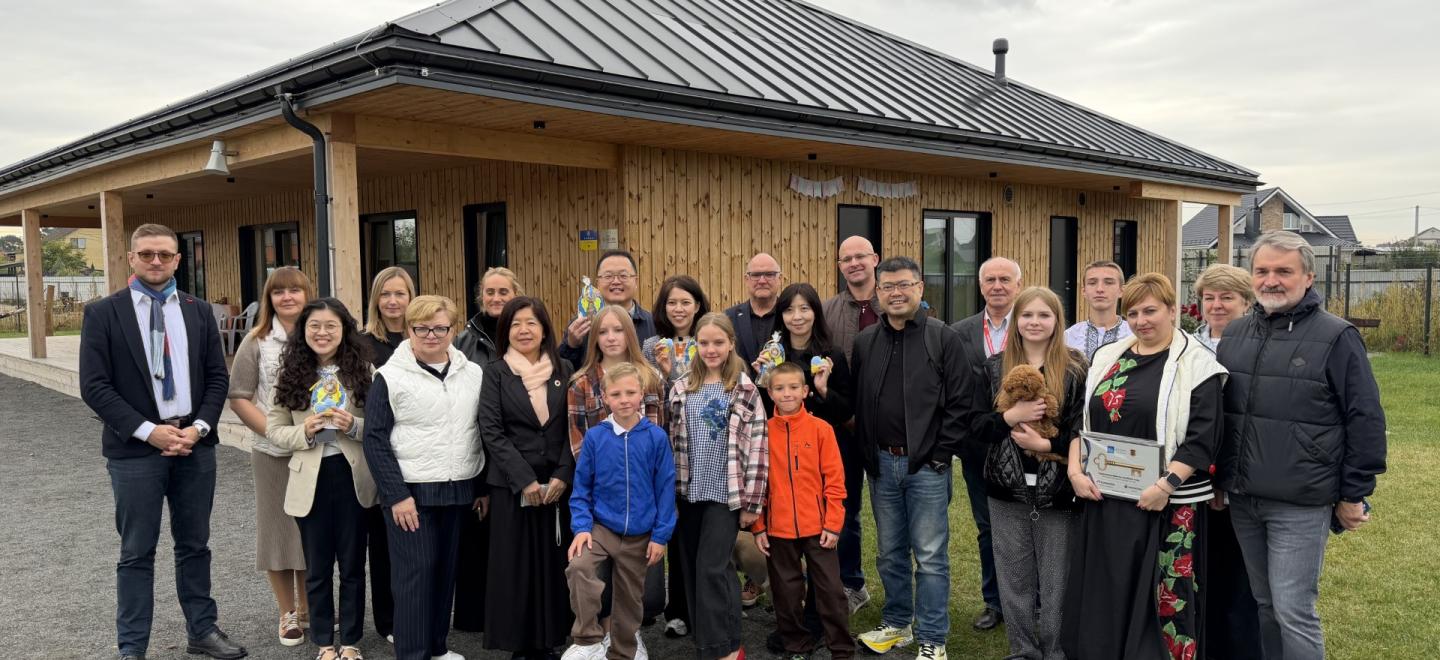
Estonia and Taiwan are jointly building a family home in the city of Zhytomyr in Ukraine for a large foster family, where children who lost their homes in the war have the space and security to grow up. The Ukrainian family who will be moving into the brand-new house in December, visited Tallinn last week.
Article originally published in Estonian by Postimees. Translated and edited for length by ESTDEV.
Klen Jäärats, executive director of the Estonian Centre for International Development (ESTDEV), told Postimees that the million-euro international agreement was signed in mid-June in Pärnu, and a builder has also been found through a public tender.
“Estonia and Taiwan have started the clock, so to speak, on when the work must be completed. We said that the family would be home by Christmas, but the construction company Matek promised even earlier. In Ukraine, of course, there is always the risk that something could happen,” said Jäärats. “In any case, we are currently slightly ahead of schedule. Matek promised that the modules will be on site by the end of August, and we can start assembling the house, which will, of course, be followed by interior work."
The Ukrainian company LLC Alexander & I, in collaboration with the Estonian subcontractor KMT Prefab OÜ, constructed the previous family-style small group homes. Nordecon won the tender for the current project. Nordecon has previously collaborated with ESTDEV to build a kindergarten and renovate an apartment building for internally displaced people; however, this is their first family home project.
This is also the first time a foreign donor has been involved. Taiwan provided money for the construction. Estonia, for its part, is symbolically contributing 50,000 euros and, in addition to supporting families, is also training social workers.
Senior project manager at ESTDEV, Anna Silem, explained that this involves additional training for people who work with children in family houses. “Unfortunately, children come to these families with a certain background and experiences,” Silem said. “The Ukrainian side has asked us to emphasise that these foster parents should also be able to maintain their own mental health and not burn out. We are trying to involve more people in our training programmes, to create a knowledge base for them. The ultimate goal is for Ukrainians to be able to address their own problems in a modern and effective manner. Our mission is to help them find their way and teach them a little along the way. We will bring them to Estonia and show them how things are going, in the same way other countries once helped Estonia. But in the end, what is important is that they can get down to business themselves and share the knowledge they have learned in their homeland, Ukraine.”
Jäärats added that it is never possible to copy what another country does, but you can gain experience and adapt it to suit yourself. “That is what we are happy to help do, and we try to support them in the best way possible, because the situation there is quite serious. Many children can no longer grow up in their own homes, and then other people take them in, and we, in turn, help with family houses,” said Jäärats.
According to Silem, people who attended training in Estonia last year said that they learned a lot about how to deal with trauma.
When asked whether it is difficult for Estonia to involve foreign aid in the reconstruction of Ukraine, Jäärats replied that ESTDEV is constantly working on this. “Sometimes you get a longer partnership, sometimes for a shorter period. Some donors prefer to support projects that are already up and running, while others are more interested in funding new initiatives where they can have greater influence or involvement. There’s no one-size-fits-all approach,” he said.
Estonia contributes 2.6% of its GNI to the reconstruction of Ukraine
Prime Minister Kristen Michal, who participated in the conference on Ukraine's reconstruction in Rome, said that Estonia must help Ukraine simply because we know very well what the fight against the occupiers entails. "You must always be on the side of what makes the world better, and I think this is clear to the Estonian people. The vast majority of us are also in favour of helping Ukraine with all the means we have,” said Michal.
The leaders of European countries met in Rome to discuss what is needed to secure Ukraine's future. "First of all, weapons and money, and all partners can contribute to this. It is noteworthy that for the first time, the United States is also participating in these discussions. President Donald Trump's stance has changed; they are no longer so optimistic about Russia, and we can move forward from here,” said Michal.
The Prime Minister confirmed that Europe will continue with sanctions against Russia, and now the same can be expected from the Americans.
“Estonia has supported Ukraine from the beginning, militarily and in other ways. Our assistance accounts for 2.6 per cent of our GNI, ranking us first in the world. Products are ordered from the Estonian defence industry, which are directed to the Ukrainian struggle. At the same time, we support our economy with this,” said Michal. “We are certainly expected to invest in Ukraine, and currently, we are primarily contributing to the reconstruction of the Zhytomyr Region. We want to help Ukraine recover as quickly as possible. We are constantly sending a message to Europe that all this must be done at the expense of Russian assets, that Russia must pay for the damage it has caused, not our taxpayers.”
Four houses completed, fifth to be ready by Christmas
Art teacher Ruslana’s family of six lives in one of the houses built with Estonian aid. Kateryna (20) is studying social work at university; Stanislav (14), Taisiia (12), Lidiia (11) and Makar (9) are attending school. The foster family was forced to move from their home on the front line in the Donetsk Region to temporary housing in Zhytomyr when the war broke out.
“The first impression of our current family home was really awesome,” said Kateryna, who was adopted into the family 11 years ago from an orphanage in the Kherson Region. “My mother had been here before and said that furniture was brought in, then something else, but the real impression came when everything was ready. I had never had my own room before, but here I got it. Everything is just wonderful here, so clean and pleasant.”
Kateryna recalled that on the morning of February 24, 2022, she went outside and wanted to go to school. "At the same time, my mother was talking to her grandfather on the phone and said, 'What school? The war has started.' The thought crossed my mind, what would happen now, what to do and where to go. My mother reassured me and said that we could do it. Already on March 13, we drove to Zhytomyr, where my mother's relatives lived. Now I'm studying social work, and it's possible that I'll start working in the same profession later," said Kateryna.
According to Kateryna, her focus is on her younger brothers and sisters, rather than parties and clubs, unlike some young women of her age. "I love and appreciate [my siblings]. Sometimes, someone may become tired of someone or something, but we can always support and help each other. We watch TV series together, go for walks or play something. I just bought an Uno board game, which is a good way to spend time. We have a habit of cleaning every day because there are two dogs and two cats living in the house. It happened like this! One of the dogs is quite big, a Labrador, and the other is a dachshund. I have to go out with them, so there's a lot to do. Parties aren't for me, and besides, I have to work. We go for walks with the girls, but to go to a club somewhere? No, I don't do that,” said Kateryna.
According to Taiisia, her first impression of the house was that it was really big. “My dream was to live in a house like this, and it came true. I now have my own room,” she said.
“I am so grateful to the people who have given us such a home,” Lidiia added.
On Saturdays, the family usually goes shopping together at the supermarket to stock up on groceries once a week. The girls get what they need from Eva’s store, then it’s the boys’ turn. The shopping trip usually takes two to three hours in total.
“I don’t feel anxious anymore. I know that everything will go as planned,” said Ruslana. "I do what depends on me; everything else depends on the children's wishes or dreams. I can think and wish, but they decide their own path. The most important thing is that they are happy now and in the future."
Related articles